
EVT 2026My Algorithm for AV Fistula Treatment
Extending patency in dysfunctional dialysis access.
By Ajit Rao, MD
Ajit Rao, MD | Mount Sinai Health System, New York, NY
Arteriovenous (AV) fistula dysfunction remains one of the most common challenges in maintaining reliable hemodialysis access. Repetitive mechanical stress, turbulent flow, and neointimal hyperplasia contribute to stenosis and thrombosis if left untreated. Although conventional percutaneous transluminal angioplasty (PTA) remains the standard endovascular treatment, elastic recoil, flow-limiting dissections, and early restenosis frequently compromise procedural durability and often necessitate repeat interventions. Despite availability of drug-coated technology and stenting in dialysis interventions, long-term patency remains relatively low, necessitating consideration of alternate treatment options.
Serration Remodeling Therapy (SRT) with the Serranator® PTA Serration Balloon (Cagent Vascular) offers a fundamentally different approach to lesion modification. By creating controlled, longitudinal micro-fissures within the intima, SRT facilitates luminal expansion while minimizing uncontrolled vessel injury. This mechanism has been shown to reduce angiographic recoil and dissections compared with conventional PTA while preserving future treatment options and avoiding permanent implants whenever possible.
The following cases highlight the use of SRT in a dysfunctional AV fistula and demonstrates how effective lesion remodeling can translate into sustained patency and favorable long-term clinical outcomes in this challenging patient population.
Treatment Algorithm
In our practice, patients undergoing fistulograms have generally been treated with balloon angioplasty with stenting reserved for recoil after angioplasty. SRT offers an additional treatment option in these challenging lesions that are often prone to recoil necessitating early reinterventions. Specifically, we consider using SRT to help prevent lesion recoil, prep the vessel for drug-coated technology, and for cases of balloon-assisted maturation, particularly at cannulation sites.
Case 1
Patient Presentation
A female patient in her early 60s with hypertension, type 2 diabetes mellitus, end-stage renal disease (ESRD) on hemodialysis via a left arm brachial artery to axillary vein AV graft (AVG) placed several years ago. Of note, she was found to have an axillary vein stenosis, which required drug-coated balloon angioplasty 6 months prior to presentation. She presented to the clinic for prolonged bleeding after hemodialysis.
Procedural Overview
An intraoperative fistulogram revealed a recurrent distal venous anastomotic stenosis at the axillary vein (Figure 1A). Through a 7-F short sheath, angioplasty of the axillary vein stenosis was performed using an 8-mm Serranator PTA Serration Balloon.
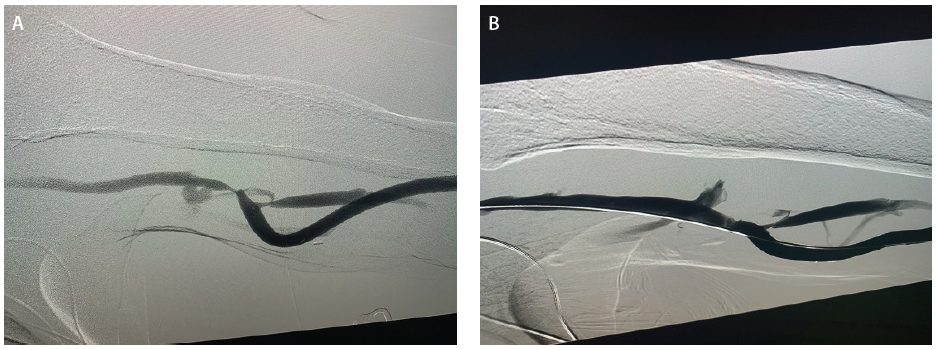
Figure 1. Diagnostic fistulogram (A). Completion fistulogram (B).
Procedural Results
A completion angiogram demonstrated complete resolution of the stenosis with brisk flow centrally (Figure 1B). The patient had an excellent thrill postoperatively and was discharged home. She was last seen in clinic at her 9-month follow-up with a patent AVG on an in-office duplex ultrasound and no evidence of restenosis.
Case 2
Patient Presentation
A male patient in his mid-70s with hypertension, type 2 diabetes mellitus, ESRD on hemodialysis via a left arm brachial artery-to-cephalic vein AV fistula placed several yearsago presented with current episodes of inability to cannulate the fistula during dialysis.
Procedural Overview
An intraoperative fistulogram revealed a long-segment stenosis of the cephalic vein in the upper arm at the cannulation sites (Figure 2A). Through a 7-F short sheath, angioplasty of the cephalic vein long-segment stenosis was performed using a 7-mm Serranator PTA Serration Balloon.
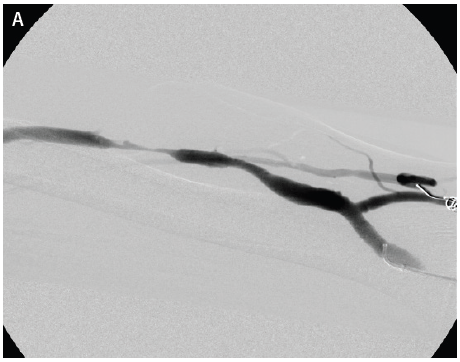
Figure 2. Diagnostic fistulogram (A).
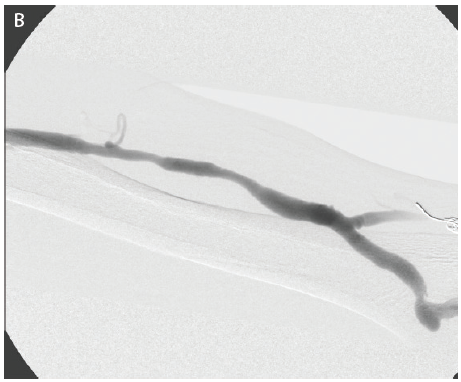
Figure 2. Completion fistulogram (B).
Procedural Results
A completion angiogram demonstrated complete resolution of the stenosis with no significant recoil (Figure 2B). The patient had an excellent thrill postoperatively and was discharged home. He was last seen in clinic at his 6-month follow-up and remains symptom-free with a patent cephalic vein on duplex ultrasonography.
Conclusion
SRT offers a new approach to lesion modification in dialysis access cases. Early experience with SRT has shown promising results and may help improve outcomes following intervention in this challenging patient population.