
EVT 2026SRT for PTAB: Predictable Lumen Expansion to Facilitate Percutaneous Transmural Arterial Bypass
By David O’Connor, MD
David O’Connor, MD | Hackensack University Medical Center, Hackensack, NJ
Case Presentation
A man in his late 40s with a history of smoking, diabetes, and coronary artery disease presented with right lower extremity rest pain and a nonhealing second toe ulcer. The patient had undergone multiple prior femoropopliteal stenting procedures at outside institutions, which subsequently occluded. A previous attempt to recanalize the occluded stents restored patency for approximately 6 months before reocclusion. With multiple failed prior interventions and no suitable saphenous vein in either leg, treatment options were limited. The reconstituted P2 popliteal segment was also small in caliber at approximately 3.5 mm, making it a suboptimal distal target for surgical bypass.
Procedural Overview
Given the complexity of the anatomy and prior treatment failures, the decision was made to perform percutaneous transmural arterial bypass (PTAB) with the DETOUR™ System (Endologix). Right lower extremity treatment was performed using left femoral arterial access and retrograde right posterior tibial venous access.
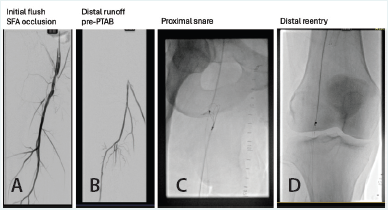
Figure 1
The initial artery-to-vein connection was created in the proximal superficial femoral artery (SFA) within an occluded segment (Figure 1A-D). The segment was first recanalized and treated with Serration Remodeling Therapy (SRT) using a 4- X 40-mm Serranator® PTA Serration Balloon (Cagent Vascular) prior to creation of the arterial-to-venous connection. Serranator was then used across the initial septum, with complete resolution of balloon waist following inflation (Figure 2A and 2B).
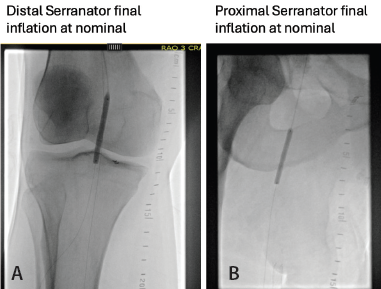
Figure 2
The procedure continued through the venous channel in standard fashion. At reentry into the P2 popliteal segment, a 4- X 40-mm Serranator balloon was again used to treat the septum. Following Serranator inflation, there was no residual balloon waist or septal stenosis, facilitating creation of the distal anastomosis and subsequent balloon treatment of the distal popliteal artery (Figure 3A-C).
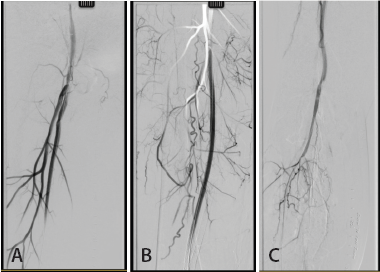
Figure 3
WHY SRT?
In this complex case, SRT provided targeted luminal expansion at critical points of the DETOUR procedure, including both initial septal creation and distal arterial reentry.
“In this complex case, SRT provided targeted luminal expansion at critical points of the DETOUR procedure, including both initial septal creation and distal arterial reentry.”